· Operations · 13 min read
What Is a Ghost Kitchen? How They Work, Costs and Profits
What is a ghost kitchen? A delivery-only kitchen with no dining room. How ghost kitchens work, business models, costs, profit margins and market size.

What Is a Ghost Kitchen?
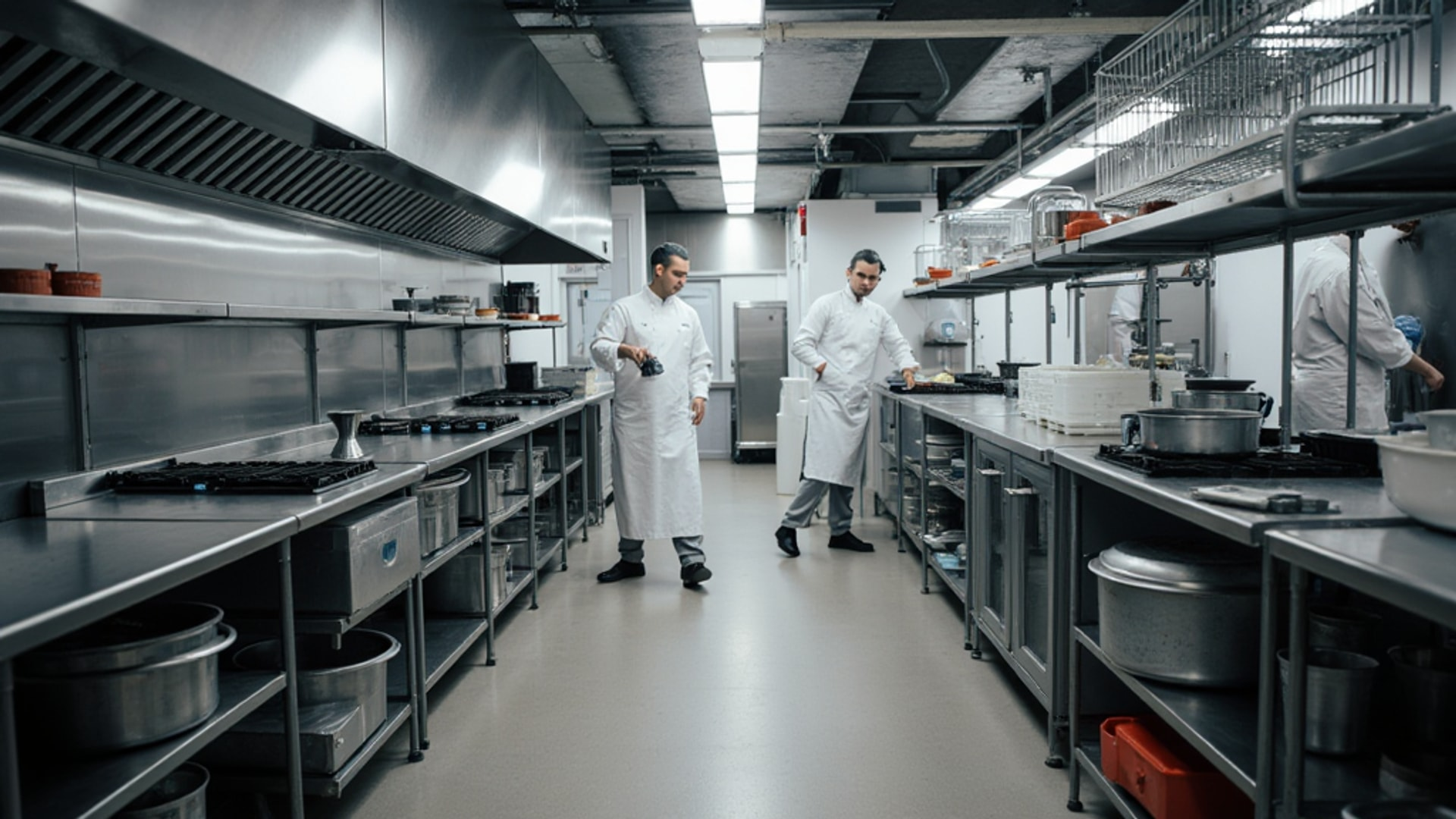
A ghost kitchen is a commercial kitchen that cooks only for delivery and takeout. It has no dining room, no counter for walk-in guests and often no sign on the door. Customers order through delivery apps or a website, cooks prepare and pack the food, and a courier collects it. The restaurant brands customers see in the app are called ghost restaurants or virtual brands.
The kitchen itself is real. It needs the same health permit, hood system, refrigeration and trained cooks as any restaurant kitchen. What’s missing is everything a guest would normally see: the room, the servers, the host stand and the rent on a street-front location. That’s the whole pitch. Strip out the front of house and you keep the part of the restaurant that makes the food.
One kitchen can run several brands at once. A single line might cook a burger brand, a wings brand and a salad brand, each with its own name and menu on the apps, sharing ingredients and staff behind the scenes.
What Is a Ghost Restaurant?
A ghost restaurant, also called a virtual restaurant, is a restaurant brand that exists only online. It has a name, a menu and listings on delivery apps, but no place where you can sit down and eat. Its food comes from a ghost kitchen, a rented shared kitchen, or the kitchen of an ordinary restaurant that runs the virtual brand alongside its own menu.
That last case is more common than most diners realize. Plenty of the “restaurants” on a delivery app are second or third brands cooked in a dine-in restaurant’s kitchen during quieter hours.
Ghost Kitchen vs. Virtual Brand vs. Cloud Kitchen vs. Dark Kitchen
The terms overlap, and people use several of them interchangeably. The useful distinction is between the kitchen (a physical place) and the brand (what the customer orders from).
| Term | What it means | Is it a place or a brand? |
|---|---|---|
| Ghost kitchen | A delivery-only kitchen with no dining room; the usual US term | Place |
| Dark kitchen | The same thing; the common term in the UK and Europe | Place |
| Cloud kitchen | The same thing; common in India, the Middle East and Asia. CloudKitchens is also the name of a US company that leases ghost kitchen space | Place |
| Ghost kitchen facility | A building divided into many private kitchen units leased to different brands, usually with a shared pickup area for couriers | Place |
| Commissary or shared-use kitchen | A licensed kitchen rented by the hour or month to caterers, food trucks and small producers; some delivery brands use them too | Place |
| Virtual brand, ghost restaurant or virtual restaurant | A delivery-only restaurant brand, cooked in any of the kitchens above or in a regular restaurant | Brand |
So a virtual brand can run out of a ghost kitchen, but it doesn’t have to. A ghost kitchen always cooks for virtual or delivery-only brands, but those may include delivery-only outposts of well-known chains.
How Do Ghost Kitchens Work?
A ghost kitchen works like the back half of a restaurant. Orders arrive from delivery apps such as DoorDash, Uber Eats and Grubhub, or from the brand’s own website; the kitchen cooks and packs them; and a courier picks them up from a pickup shelf or window. The delivery platform collects payment from the customer, takes its commission and pays the restaurant on a set schedule.
| Step | What happens | What matters most |
|---|---|---|
| 1. Order | The customer orders in a delivery app or on the brand’s website | Menu photos, ratings and price; the app’s ranking decides who sees you |
| 2. Ticket | The order lands on a tablet, or in software that pulls every app into one screen and sends it to the kitchen display | One order screen, not one tablet per app per brand |
| 3. Cook | The line prepares the order to a quoted prep time | Speed and consistency; a menu designed for one or two stations |
| 4. Pack | Food is packed, sealed and checked against the ticket | Packaging that holds temperature and texture; order accuracy |
| 5. Handoff | The bag goes to a pickup shelf; the app assigns a courier | A clear pickup point so couriers don’t walk through the kitchen |
| 6. Delivery | The courier delivers; the customer rates the order | Arrival quality, which drives ratings and future ranking |
| 7. Payout | The platform pays out sales minus commission, fees and refunds | Refunds for missing items come out of your payout |
Ratings and accuracy aren’t just vanity metrics. The platforms set rules for virtual brands. When Uber Eats removed about 5,000 duplicate virtual brands in 2023, it also required a virtual brand’s menu to differ by at least 60 percent from its parent restaurant and any sibling brands, a rating of 4.3 stars or higher, and merchant cancellations and inaccurate orders each at 5 percent or lower, Food On Demand reported. Running five copies of the same menu under different names no longer works.
For the physical setup, see ghost kitchen design for layout and courier handoff, and setting up a ghost kitchen for equipment, permits and staffing. What goes on the menu is its own discipline, covered in ghost kitchen menu strategy.
Ghost Kitchen Business Models
There are five main ways to run a ghost kitchen. They differ in how much you invest up front, how much control you keep, and who carries the lease.
| Model | How it works | Cost profile | Best for | Watch out for |
|---|---|---|---|---|
| Restaurant-run virtual brand | An existing restaurant adds one or more delivery-only brands to its kitchen | Lowest: menu development, packaging, photos and platform setup; staff and equipment already paid for | Restaurants with spare kitchen capacity in off-peak hours | Delivery orders slowing the dine-in line at peak; platform rules on duplicate menus |
| Unit in a ghost kitchen facility | You lease a private kitchen unit in a purpose-built building; the operator provides the hood, utilities and often courier handoff | Monthly rent and fees plus your equipment and staff; less build-out than a standalone kitchen | New brands, and chains testing delivery in a new area | Multi-year lease terms; whether the facility sits where your customers are |
| Commissary or shared kitchen by the hour | You rent time in a licensed shared kitchen | Hourly rent: $15 to $45 nationally, most commonly $20 to $29 (The Food Corridor, 2023 operator survey) | Very small starts, caterers adding delivery | Shared equipment, limited storage, rules on courier traffic |
| Standalone delivery kitchen | You lease and build out your own small kitchen in a cheaper, non-retail location | Full kitchen build-out including ventilation; lower rent than a street-front site | Operators with proven delivery demand | You carry the lease and the build-out risk alone |
| Licensed virtual brand | A company licenses a ready-made brand and menu to restaurants that cook it | Fees or revenue share to the licensor, plus ingredients and packaging | Restaurants wanting volume without developing a brand | Quality control and brand risk you don’t control |
Licensed brands show how the last model can go wrong. Virtual Dining Concepts ran MrBeast Burger through restaurants and commercial kitchens nationwide. In 2023 Jimmy Donaldson (MrBeast) sued the company, alleging it had damaged his reputation by serving “low quality” and sometimes “inedible” food; the company denied it and countersued for breach of contract, NBC News reported. A brand cooked by hundreds of kitchens is only as good as the worst of them.
Startup costs vary more by model than by concept. A virtual brand in an existing kitchen can launch for little more than packaging and photography, while a standalone build-out with a hood system costs far more. CloudKitchens, which leases ghost kitchen space and so has a stake in the comparison, puts the cost of launching a ghost kitchen at around $30,000 against more than $1 million for a traditional restaurant. Our guide to starting a cloud kitchen breaks down the startup costs in detail.
Are Ghost Kitchens Profitable?
Some ghost kitchens are profitable, but fewer than the pandemic-era hype suggested. A ghost kitchen saves on rent and front-of-house labor, then gives much of that saving back to the delivery apps, which charge commissions of 15 to 30 percent of each order on their main US plans. The delivery-only kitchens that make money usually have high order volume, tight food and packaging costs, and a share of orders through their own channel.
The commission is the number that decides everything. These are the US delivery commission tiers in late 2026:
| Platform | Plan | Delivery commission |
|---|---|---|
| DoorDash | Basic / Plus / Premier | 15% / 25% / 30% |
| Uber Eats | Lite / Plus / Premium | 20% / 25% (30% on Uber One member orders) / 30% |
Uber Eats raised its Lite rate from 15 to 20 percent in March 2026 and its pickup commission from 6 to 7 percent, with 10 percent on pickup orders without validated in-store pricing. The cheaper tiers come with a smaller delivery radius and less visibility in the app, so the low rate often means fewer orders. Check current rates in your merchant portal before you build a forecast, since they vary by market and change often.
Here’s what that does to a single order. The figures below are illustrative assumptions, not industry averages: a $30 order, food cost at 30 percent, $1.50 of packaging, labor at 25 percent, and 12 percent for rent, utilities, software and marketing.
| Per $30 order | On a 15% plan | On a 30% plan |
|---|---|---|
| Order value | $30.00 | $30.00 |
| Delivery commission | −$4.50 | −$9.00 |
| Food cost (30%) | −$9.00 | −$9.00 |
| Packaging | −$1.50 | −$1.50 |
| Labor (25%) | −$7.50 | −$7.50 |
| Rent, utilities, software, marketing (12%) | −$3.60 | −$3.60 |
| Left before tax | $3.90 (13%) | −$0.60 (−2%) |
That right-hand column is why so many delivery-only brands lose money. On the plans that give real visibility, a cost structure that would be healthy in a dine-in restaurant leaves nothing. The levers that change the result are the ones you’d expect: more orders per labor hour, menus that share ingredients across brands, higher prices on the apps than in store where the platform allows it, and moving repeat customers to your own ordering channel. Delivery app marketing and the delivery platform comparison cover the platform side.
Ghost Kitchen Profit Margin
There’s no reliable industry-wide figure for ghost kitchen profit margins. Vendors publish claims of 10 to 30 percent, but those come from companies selling to ghost kitchens and rarely show their workings. Restaurants in general run on thin margins, often in the low single digits (see financial benchmarks by concept), and a delivery-only kitchen paying top-tier commissions has no obvious reason to beat them. Build the per-order model above with your own numbers before you believe anyone’s margin claim, including ours.
How Much Do Ghost Kitchens Make?
A ghost kitchen’s revenue is orders per day × average order value × days open. A delivery-only kitchen doing 60 orders a day at a $30 average, seven days a week, takes in about $54,600 a month. What it keeps depends on the commission tier and its costs: on the illustrative model above, that’s roughly $7,100 a month before tax on the 15 percent plan, and a small loss on the 30 percent plan.
A virtual brand inside an existing restaurant works differently. Rent and much of the labor are already paid by the dine-in business, so each extra order mostly needs to cover food, packaging and commission. That’s why restaurant-run virtual brands are the most consistently profitable version of the model, as long as they don’t slow the main kitchen at the times it’s busiest.
Ghost Kitchen Failures and Consolidation
The ghost kitchen boom was followed by a sharp correction, and several of the best-known bets were scaled back or closed:
- Wendy’s committed in 2021 to 700 delivery kitchens with Reef Technology across the US, UK and Canada by 2025. About a year later it cut the goal to 100 to 150, and in 2023 it closed its remaining US Reef units, Restaurant Dive reported.
- Kitchen United closed all eight of its Kroger locations, 44 percent of its 18-unit footprint, and said in November 2023 that it would sell or close all of its physical sites to focus on software (Restaurant Dive).
- Uber Eats removed about 5,000 duplicate virtual brands in 2023 and tightened its standards, as described above.
None of that means the model is dead. It means the version that attracted the venture money, thousands of new brands with no reputation living entirely on app traffic, mostly didn’t work. What survived is attached to something customers already trust: a restaurant with a dining room, a known chain extending its delivery area, or a concept being tested before it gets a lease. The ghost kitchen evolution traces that shift from hype to hybrid models, and ghost kitchen operations works through the economics of real operations.
Ghost Kitchen Market Size
Estimates of the ghost kitchen market vary widely because research firms define it differently. Global estimates for 2025 and 2026 cluster around $97 billion to $113 billion, while a narrower count of US businesses that run ghost kitchen facilities puts that industry at about $2.9 billion.
| Source | Scope | Size | Forecast |
|---|---|---|---|
| Coherent Market Insights | Global | $99.3 billion (2026 estimate) | $223.7 billion by 2033 (12.3% a year); North America about 31.7% of the 2026 market |
| The Business Research Company (February 2026) | Global | $97.2 billion (2025); $113.0 billion (2026) | $204.3 billion by 2030 (16% a year); North America the largest region in 2025 |
| IBISWorld | US ghost kitchen industry | $2.9 billion (2025) | Revenue down 0.1% in 2025 |
For the US ghost kitchen market, the gap between those numbers is the story. Coherent’s North America share works out to roughly $31 billion in 2026 (our calculation from its figures). The global reports treat ghost kitchens as a broad category whose users include restaurants, caterers, meal-prep companies and packaged food producers, and they don’t spell out exactly what their revenue figure includes. IBISWorld counts only US businesses that operate ghost kitchen facilities and prepare food for other businesses under contract, and by that measure the industry is small and flat. Read the definition before you quote any of these numbers, and treat forecasts with caution; the pandemic-era projections were far higher than what followed.
Ghost Kitchen vs. Restaurant Franchise
If you’re weighing a delivery-only concept against buying a franchise, the trade is between low cost with no brand and high cost with a proven one.
| Factor | Your own ghost kitchen brand | Licensed virtual brand | Traditional restaurant franchise |
|---|---|---|---|
| Upfront cost | Low to moderate, depending on the kitchen model | Low if run in an existing kitchen | High: franchise fee plus build-out, disclosed in the franchise disclosure document |
| Brand awareness on day one | None | Borrowed from the licensor | Established |
| Ongoing fees | Platform commissions | License fee or revenue share, plus commissions | Royalties and marketing fund contributions |
| Control over menu and operations | Full | Set by the licensor | Set by the franchise system |
| Main risk | Building a brand from nothing on the apps | The licensor’s brand and quality problems | A large investment and a long lease |
A franchise buys you a brand customers already look for, which is exactly what most failed ghost kitchens lacked. A ghost kitchen buys you a cheap test. Read any license or franchise agreement with a lawyer before signing; our guides to franchise considerations and franchise disclosure law explain what to look for.
Who Should Open a Ghost Kitchen (and Who Shouldn’t)
A ghost kitchen suits:
- Restaurants with kitchen capacity that sits idle in off-peak hours
- Established brands extending their delivery area without building another dining room
- Operators who want to test a concept and prove demand before signing a lease
- Food that travels well (bowls, burgers, wraps, curries, pizza) in dense delivery markets
It’s a poor fit for:
- First-time operators with no brand and no delivery data who are counting on app traffic to find them
- Concepts built on hospitality, atmosphere or food that has to be eaten the moment it’s plated
- Low-density areas where couriers are slow and order volume is thin
- Anyone whose numbers only work on a 15 percent commission plan while needing a top-tier plan to get seen
If you fit the first list, start with the menu and the per-order math, not the kitchen. Run the numbers above with your own costs and your realistic commission tier. If the order still makes money at 30 percent, you have a business worth building.