· Starting a Restaurant · 9 min read
Restaurant Equipment Checklist: What to Buy, Lease, or Skip
Don't buy everything before you open — a phased equipment strategy saves tens of thousands in upfront capital and lets real operations tell you what you actually need.

Equipment decisions are where a lot of first-time restaurant owners lose perspective. The catalog arrives, the showroom visit happens, and suddenly the list of things that would be nice to have in the kitchen has expanded to three pages and a price tag that blows the startup budget. Then the restaurant opens and half of that equipment sits idle because the menu turned out not to require it.
The smarter approach is phased acquisition — buying what you absolutely need before opening, letting real operations reveal what you actually use, and making larger investments once you understand your own kitchen from the inside. According to GoFoodservice’s equipment purchasing guide, the pre-opening phase should focus exclusively on absolute necessities, with additional equipment added at 2-4 weeks post-opening and larger investments deferred to 3-6 months in when you understand your true operational needs.
This approach also reflects basic financial discipline. Equipment represents one of the largest upfront capital expenditures in a restaurant startup. Spreading those expenditures across the first months of operation preserves working capital for the period when you need it most.
The Core Equipment List: Before Opening
These are the items you need on day one. Nothing on this list is optional. Everything else is addable.
Cooking Equipment
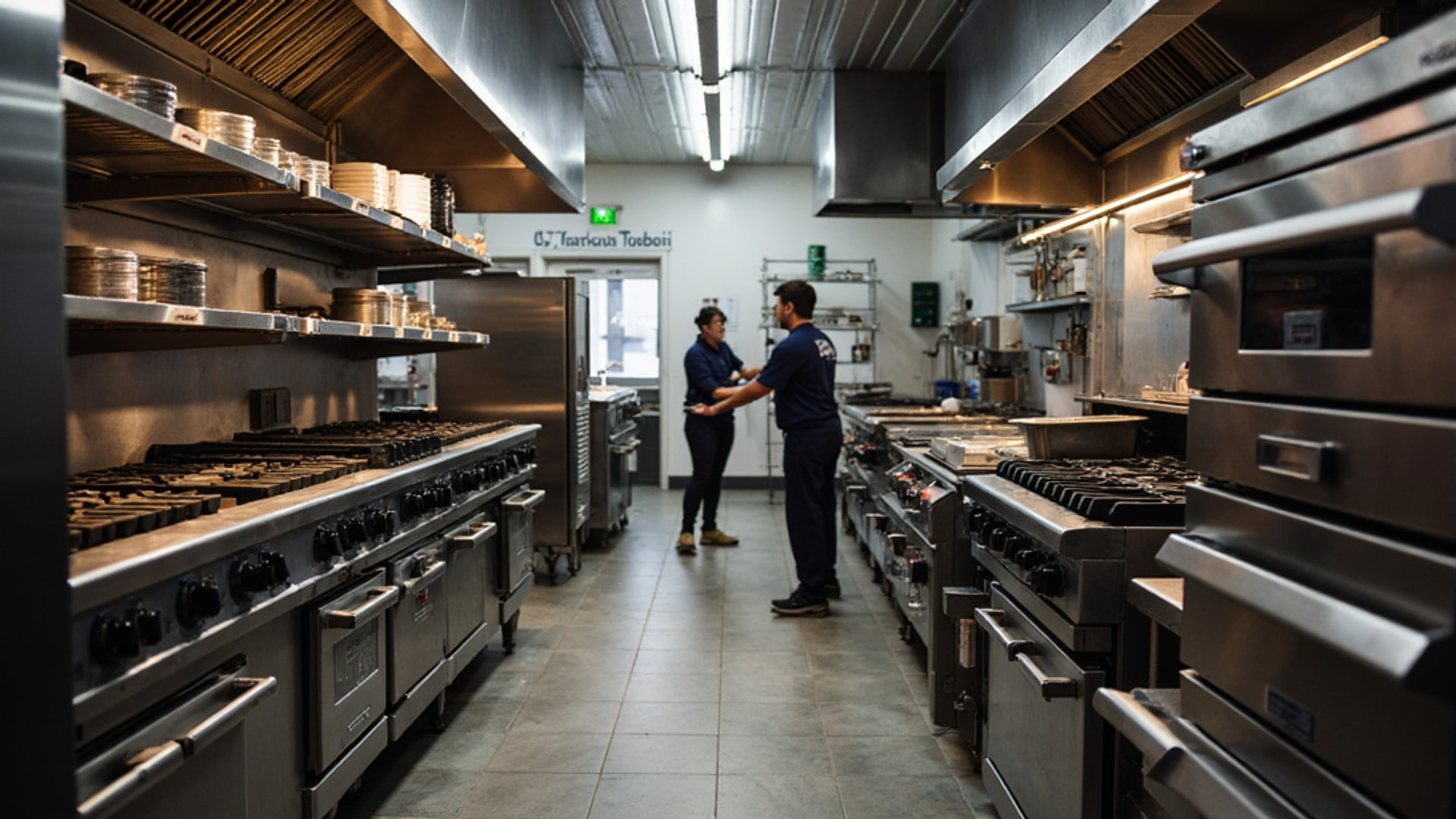
Commercial ranges are the foundation of most kitchens. Available in gas and electric configurations, commercial ranges combine a cooktop and oven in a single unit. Choose the number of burners based on your menu’s actual cooking requirements, not aspirational capacity. A 6-burner range serves most small to mid-sized kitchens; go to 10 or 12 burners only if your menu genuinely requires it.
Convection ovens circulate hot air for even cooking and faster cook times than conventional ovens. They are workhorses for roasting, baking proteins, and finishing dishes. According to Toast’s essential equipment guide, convection ovens are standard in most commercial kitchens for this reason.
Deck ovens for pizzerias, bakeries, or any concept where artisan bread or pizza is central. These are specialized and expensive — justify the cost only if your concept requires them.
Combi ovens combine convection and steam cooking, offering exceptional versatility. They are expensive but can replace multiple pieces of equipment in space-constrained kitchens.
Commercial fryers in countertop or floor models with single or double baskets. If your menu includes any fried items, a fryer is non-negotiable before opening. Size your fryer capacity to your anticipated volume — undersized fryers create service bottlenecks immediately.
Flat-top griddles and charbroilers for any concept serving burgers, breakfast items, or grilled proteins. Match the equipment to your menu, not to the available space.
Salamanders and broilers for finishing dishes, melting cheese, and browning. A salamander is a relatively modest investment that adds significant finishing capability.
Refrigeration
The FDA requires refrigerated food to be stored at 40 degrees F or below. Adequate refrigeration is not optional — it is a food safety requirement and a health code prerequisite for operation.
Walk-in coolers provide bulk cold storage and are standard in most full-service restaurants. Size matters: undersized walk-ins create inventory management nightmares and force frequent deliveries. As a rough guide, a 40-seat restaurant typically needs at minimum an 8x8 walk-in; larger operations require proportionally more capacity.
Walk-in freezers for proteins, frozen inventory, and batch-prepared items. The balance between walk-in cooler and freezer space depends on your menu’s fresh-versus-frozen ratio.
Reach-in refrigerators on the line for frequently accessed items during service. Station-specific reach-ins reduce the number of times cooks walk to the walk-in during service, improving speed and food safety by reducing cold chain interruptions.
Under-counter refrigeration saves floor space in tight kitchens and provides cold storage directly at the point of use.
Prep table refrigerators — lowboys with rail sections for holding prepped ingredients — are essential for sandwich, salad, and pizza stations.
Food Preparation Equipment
Commercial food processors for batch work: sauces, purées, dressings, vegetable processing. The capacity you need depends on your prep volume.
Commercial mixers are non-negotiable for any bakery, pizza, or pasta concept. For other concepts, evaluate based on actual bread and dough production requirements.
Food slicers for any operation that butchers deli meats or requires consistent vegetable or protein slicing.
Stainless steel prep tables are the standard for all prep surfaces. According to Toast’s equipment guide, stainless steel is standard due to bacteria resistance, durability, and cleanability. All prep surfaces should be NSF-certified. Size and configure your prep table space based on your production volume and menu complexity.
Commercial food scales for portion control and recipe consistency. Every kitchen needs at least one accurate scale.
Sanitation and Warewashing
Commercial dishwashers — either door-type or conveyor models depending on your volume. The health department will specify minimum wash and rinse temperature requirements; your dishwasher must meet them. Under-counter models work for low-volume operations; high-temperature door-type machines handle most full-service restaurants.
Three-compartment sinks are required by health code in every commercial kitchen regardless of whether you also have a commercial dishwasher. The three-compartment system — wash, rinse, sanitize — is the baseline manual warewashing method and the legal alternative to mechanical dishwashing.
Handwashing stations must be installed in number and placement specified by your local health code. These are separate from the three-compartment sink. A dedicated handwashing sink in the kitchen and additional stations in food prep areas are standard requirements.
Grease interceptors are required by most municipalities to prevent grease from entering the municipal sewer system. Size requirements are calculated based on your drain flow rate and must be specified during kitchen design.
Storage and Shelving
Commercial shelving for dry storage, walk-in organization, and equipment storage. According to Toast’s equipment guide, shelving should use chrome wire, epoxy-coated, or stainless steel materials — wood shelving is typically prohibited in commercial kitchen environments by health codes.
Sheet pans and hotel pans in a full complement of sizes for cooking, storage, and service. These are consumables that wear out, so buy more than you think you need.
Food storage containers in a standardized set of sizes that nest and stack efficiently. Standardization matters — a kitchen where containers are mismatched creates storage chaos and food safety risks.
Equipment to Add 2-4 Weeks Post-Opening
According to GoFoodservice, operational experience reveals needs that pre-opening planning cannot fully anticipate. After two to four weeks of actual service, specific bottlenecks, capacity constraints, and workflow inefficiencies become visible. Common additions at this stage include:
- Specialized cooking equipment for menu items that proved more popular than anticipated
- Additional prep equipment for high-turnover ingredients
- Upgraded smallwares for specific stations that need better tools
- Additional cold storage if your walk-in is running tight
- Equipment that addresses bottlenecks identified during the opening rush
The key insight here is that decisions made after a few weeks of real operations are far better informed than decisions made based on pre-opening projections. Spending an extra $5,000 on equipment that genuinely solves a demonstrated problem is more valuable than spending that $5,000 pre-opening on equipment that seemed like it would be useful.
Equipment to Defer to 3-6 Months
According to GoFoodservice, larger equipment investments should wait until established demand justifies them. These items represent significant capital outlay and should be purchased only when you understand your true operational requirements:
- High-capacity conveyor dishwashers (appropriate only at proven high volume)
- Specialized production equipment for batch processes
- Walk-in freezer expansion if the concept scales
- Dedicated pastry equipment if the pastry program develops beyond initial projections
Buying, Leasing, and Financing
Equipment financing is the most common acquisition method for commercial kitchen equipment.
→ Read more: Kitchen Equipment Leasing vs. Buying: When Each Makes Financial Sense GoFoodservice reports that financing terms typically run 12 to 72 months with 10 to 20 percent down payments. For major equipment purchases, SBA loans offer government-backed financing up to $5 million with favorable terms.
Equipment leasing preserves working capital and transfers some maintenance risk to the lessor. The tradeoff is that you build no equity in leased equipment and pay more over the full term than you would by purchasing. Leasing makes the most financial sense for technology-heavy equipment that depreciates quickly or requires regular replacement, or for equipment you want to test before committing to a purchase.
Supplier financing, sometimes offered at 0% interest for the first 12 months, is worth asking about. According to GoFoodservice, some equipment vendors offer this as a competitive incentive. Get this in writing and understand what the rate becomes after the promotional period ends.
Buying in bundles from a single supplier can produce savings of 10 to 15 percent compared to sourcing individual items from multiple vendors. GoFoodservice recommends this approach for larger equipment purchases — consolidating to one supplier simplifies the purchasing process, reduces shipping complexity, and creates leverage for volume pricing.
Refurbished equipment is appropriate for non-mission-critical items and can substantially reduce costs. A refurbished prep table or shelving unit performs identically to new for a fraction of the price. Be more cautious with critical refrigeration equipment and cooking equipment where reliability directly affects food safety and service quality.
Energy Efficiency as a Financial Decision
ENERGY STAR certified equipment reduces energy costs by 15 to 30 percent, according to Toast’s equipment research.
→ Read more: Kitchen Equipment Essentials: What to Buy, What to Skip, and How to Save In 2025 and beyond, with rising energy costs, this certification has become standard practice rather than a premium choice. Many utility companies offer rebates for ENERGY STAR commercial equipment purchases, and some jurisdictions provide tax credits as additional incentives.
Run the numbers on energy-efficient models before defaulting to the least expensive option. The premium on an ENERGY STAR refrigeration unit often pays back within 18 to 24 months through reduced utility costs — and then continues generating savings for the remaining 8 to 10 years of the equipment’s life.
Before You Buy Anything
GoFoodservice recommends two prerequisites before purchasing any equipment: measure your kitchen layout precisely, and contact key vendors 3 to 6 months before your target opening to build relationships and share your timeline.
The layout measurement requirement seems obvious, but equipment arrives at restaurants every month that does not fit through the door, cannot be positioned as planned because a drain is in the wrong place, or conflicts with hood clearance requirements that were not measured accurately. Measure the space, measure the doorways, and account for installation clearances around cooking equipment before placing any orders.
The vendor relationship timeline — reaching out 3 to 6 months before opening — is not just about delivery scheduling. It is about getting access to the vendor’s expertise during your planning phase. Equipment vendors who know your concept, your kitchen layout, and your timeline can advise on equipment selection, flag potential issues, and sometimes provide better pricing to clients who have given them enough lead time to plan production accordingly.
End-of-season and holiday sales also offer opportunities for discounted purchases that are worth planning around. And always negotiate extended warranties and service agreements at the time of purchase — that is the moment when the vendor is most motivated to include them.