· Menu & Food · 9 min read
Food Cost Control Tips: Practical Daily Systems That Actually Work
The daily, weekly, and monthly practices that control food costs — from tracking actual versus theoretical to portion discipline and supplier management.
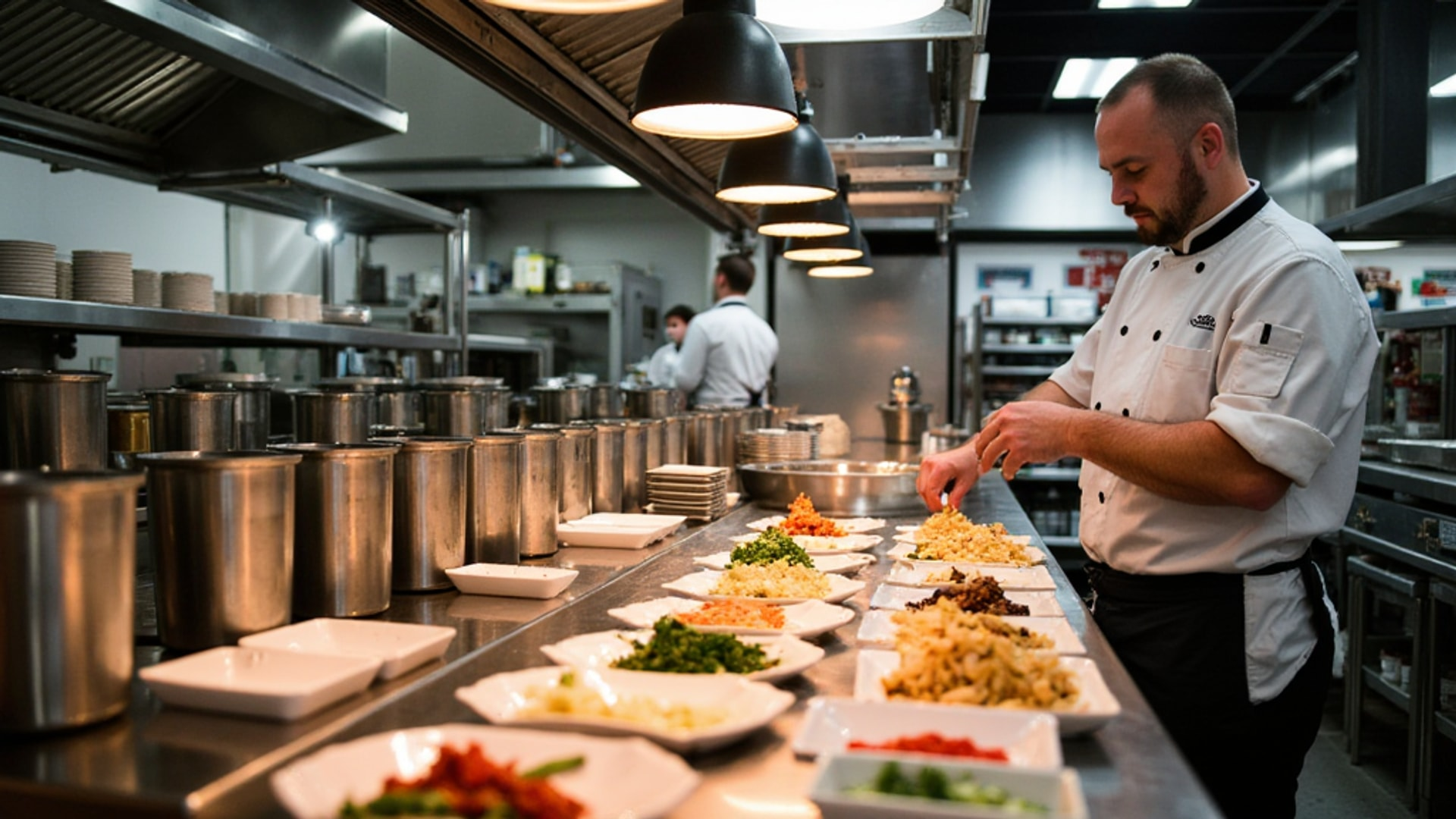
Food cost is the most visible variable in restaurant financial management, and it is the one that operators most often try to improve with a single tactic — usually either a supplier change or a price increase — rather than a system. The tactic approach fails because food cost is not one problem with one solution. It is the aggregate result of dozens of decisions made every day across purchasing, receiving, storage, prep, production, service, and sales.
→ Read more: Food Cost Formulas Every Restaurant Owner Should Know
Industry benchmarks put the target range at 28–35% of revenue for most concepts. Full-service restaurants averaging 3-6% net profit margins, according to National Restaurant Association industry data, cannot afford to operate much above their target range for long. But tightening food cost to within acceptable bounds requires understanding where the leakage is actually happening — and that requires measurement, not guesswork.
Start with the Actual vs. Theoretical Gap
The most important food cost metric that most operators do not track is the gap between theoretical food cost and actual food cost. Without this comparison, you cannot know whether your costs are being lost to waste, poor portioning, theft, unrecorded comps, or inaccurate purchasing.
Theoretical food cost is what your cost should be if every dish were produced exactly to recipe specification and every portion were served at exactly the specified weight, with no waste, no theft, and no unaccounted comps. Calculate it by multiplying the recipe cost of each menu item by the number of units sold (from your POS PMIX report), then dividing the total theoretical cost by total food revenue.
Actual food cost is calculated from inventory: beginning inventory plus purchases minus ending inventory, divided by total food sales. The formula from Popmenu’s food cost analysis: (Beginning Inventory + Purchases − Ending Inventory) ÷ Total Food Sales × 100.
If theoretical shows 29% and actual shows 35%, you have a 6-point gap. Six percent of revenue is leaking somewhere. Finding where requires investigating each of the loss points in sequence: portion control, prep waste, server errors, unrecorded staff meals, receiving discrepancies, and storage losses. The gap tells you the problem exists; investigation identifies the specific failure.
Track Food Costs Daily, Not Just Monthly
Monthly food cost calculations are necessary for accounting, but they are too infrequent to catch problems before they compound. According to the Typsy hospitality management blog, “using daily purchases against daily revenue provides early warning of rising costs.”
Daily tracking does not need to be precise to be useful. A simplified daily food cost tracking system works as follows: record yesterday’s food purchases, divide by yesterday’s food revenue, and compare to your target. The precision improves as you move through the month — Typsy notes that figures “become most accurate by weeks three and four of the month” — but daily monitoring creates an early warning system that monthly calculations cannot provide.
A day where purchases-to-revenue spikes unexpectedly prompts an investigation before the pattern has repeated for three weeks. It might reveal that a product arrived damaged and had to be discarded, that a catering order required additional purchasing at short notice, or that a delivery was invoiced for the wrong quantity. Any of these is correctable if caught early; none is easily addressed if discovered a month later.
→ Read more: Kitchen Food Cost Control: From Theoretical to Actual — Closing the Gap
Standardize Recipes and Enforce Portion Controls
The most direct driver of food cost consistency is portion standardization. When two cooks prepare the same dish with different amounts of the primary protein, the food cost of that dish varies with each portion — and the average actual cost diverges from the theoretical cost based on recipe cards. Over hundreds of covers, that divergence accumulates into significant cost variance.
Standardized recipe cards should specify exact quantities by weight, not volume, for anything where precision matters. Weight is more accurate than volume for proteins and solid ingredients; scales eliminate the eyeballing that creates portion drift. Every position in the kitchen should have access to the recipe cards for the dishes they produce.
Portion control tools — scoops, ladles, portioning spoons, and scales — must be available and used consistently. Tools sitting in a drawer do not enforce portions. Training that explains why portions matter (connecting kitchen behavior to financial outcomes) produces better compliance than training that only explains the how.
Typsy’s practical tips include the observation that “without standardized recipes specifying exact quantities for every ingredient, each cook prepares dishes differently, making cost prediction impossible.” The investment in the documentation and training is also the foundation of food cost predictability.
Address Waste Across All Nine Control Points
Food cost leakage occurs at nine traditional control points in food service operations: purchasing, receiving, storage, inventory handling, issuing, production, service, sales, and cash control. Most cost-improvement efforts focus on one or two of these — usually purchasing and production — while ignoring the others. According to Typsy’s food cost management analysis, “addressing only one or two leaves money on the table.”
Purchasing: Are you buying what you actually need, or is over-purchasing leading to spoilage? Predictive ordering aligned with forecasted covers reduces over-purchasing. According to Peppr POS’s benchmarking data, AI-powered predictive ordering reduces over-purchasing by 20-30% for operations that implement it.
Receiving: Is everything you ordered arriving at the specified quantity, quality, and price? Receiving discrepancies — short weights, wrong products, damage — that are not caught at the dock become losses that inflate your actual food cost. Every delivery should be checked against the purchase order.
Storage: First-in, first-out (FIFO) rotation prevents older product from spoiling behind newer deliveries. Temperature compliance protects perishables. Proper labeling ensures that staff know what is in containers and when items were prepared. Storage losses that go untracked inflate actual food cost invisibly.
Issuing: In larger operations, controlling the movement of ingredients from the walk-in to the production line prevents untracked product movement. Issue logs create accountability for what leaves storage.
Production: Prep waste — trim loss, broken portions, mistakes that require remaking — all register as cost without generating revenue. Tracking prep yield against expected yield identifies where prep waste is above norm.
Service: Over-portioning during plating, re-fires due to kitchen errors, and food returned from the table all add to actual food cost. Order accuracy reduces re-fires; portion tools and plating guides reduce service variance.
Sales and cash control: Unrecorded orders, split checks where food is not properly rung up, and comps that are not recorded in the POS all inflate apparent food cost by reducing the revenue against which cost is measured.
Optimize the Sales Mix
Food cost percentage is an average across all menu items, weighted by the volume of each item sold. When a restaurant sells a high percentage of high-cost items (expensive proteins, rich preparations), the blended food cost rises even if every item is being produced at its recipe specification.
Server training can influence this mix. Typsy’s analysis recommends “training servers to upsell strategically by pairing high-cost items with lower-cost add-ons.” A high-margin appetizer paired with a moderate-margin entree produces a better average ticket economics than selling the entree alone. Beverages — which typically carry pour costs of 18–24% compared to food costs of 28–35% — are the most powerful sales mix lever available, and servers who effectively suggest wine pairings, cocktails, and premium non-alcoholic options improve the blended cost across the entire ticket.
Menu engineering (the Stars, Plowhorses, Puzzles, and Dogs matrix) provides the strategic framework for this. Promoting items with strong contribution margins through menu placement, server training, and descriptions reduces the proportion of low-margin Plowhorse dishes in the sales mix without removing items that customers love.
Manage Portions When Costs Rise
When ingredient costs increase and immediate menu price increases are not appropriate, portion adjustment is the most surgical alternative. Typsy’s cost management guidance describes the approach: “analyze each menu item to find adjustments that improve financial performance without noticeably reducing the customer’s perception of value.”
This requires careful judgment. A 10% reduction in a side dish portion often goes unnoticed. A 10% reduction in the primary protein on an entree that customers specifically come for is noticed and generates negative feedback. The key is finding the adjustments that reduce cost without crossing the threshold of perceptible change.
Changes to presentation can sometimes accompany portion adjustments to maintain perceived value. A slightly smaller protein portion that is sliced and fanned on the plate, surrounded by elevated accompaniments, can feel more generous than a larger piece presented without attention to appearance.
Renegotiate with Suppliers Regularly
Ingredient cost is the only food cost lever that reduces both actual and theoretical costs simultaneously — because it changes the cost calculation at the source. Typsy recommends meeting formally with suppliers at least three times per year, leveraging their expertise on seasonal availability, pricing trends, and product quality.
Suppliers have market knowledge that most restaurant operators lack. When a category is experiencing price pressure, suppliers who value the relationship will often provide advance warning or suggest specification alternatives. A request for a lower-grade beef trim for a braised dish that will be cooked for hours — where the grade difference disappears in execution — can reduce protein costs significantly without any quality impact on the finished dish.
Joining a group purchasing organization (GPO) such as those listed by Foodbuy gives smaller operators collective buying power they cannot achieve independently. Lightspeed’s food cost analysis notes this as a cost-reduction strategy that can access pricing unavailable to individual operators negotiating alone.
Use Data to Identify Emerging Trends
Food cost management is not a one-time fix but an ongoing analytical discipline. Typsy’s guidance includes tracking metrics like average guest check, food sales per seat, and turnover per seat to reveal patterns that inform purchasing and menu adjustments.
When food cost starts creeping upward over three or four consecutive weeks, something systematic is changing — whether it is ingredient costs, portion drift, sales mix shift, or waste accumulation. The trend is visible in weekly data; invisible if you check monthly. Early detection means early correction, before the margin impact has accumulated through a full quarter.
The combination of daily tracking, monthly actual versus theoretical comparison, quarterly recipe cost review, and annual supplier renegotiation creates a food cost management system where the feedback loops are tight enough to catch problems quickly and structured enough to produce consistent improvement over time. That system is what separates operators who consistently perform at target food costs from those who wonder every month why the numbers are not where they should be.
→ Read more: Recipe Standardization: Building Consistent, Profitable Dishes at Scale → Read more: Inventory-Driven Menu Planning: Using Par Levels to Prevent Waste and Stockouts