· Kitchen · 8 min read
Kitchen Fire Suppression Systems: Requirements, Costs, and Compliance
What every restaurant operator needs to know about fire suppression system requirements, NFPA 96 and UL 300 compliance, ANSUL R-102 installation, and the ongoing inspection schedule that keeps your coverage valid.

A grease fire in a commercial kitchen moves fast. You have seconds, not minutes. The fire suppression system integrated into your Type I hood is designed to activate before your staff even reaches for an extinguisher, and it has to work perfectly the first time — because there may not be a second chance to get it right.
Understanding fire suppression requirements is not just a code compliance exercise. It’s the difference between a kitchen incident that’s contained and cleaned up in a few hours and a fire that destroys your business.
The Regulatory Framework
The primary code governing fire suppression in commercial kitchens is NFPA 96: Standard for Ventilation Control and Fire Protection of Commercial Cooking Operations. Most states have adopted NFPA 96, either directly or as part of their fire codes, and local jurisdictions often layer additional requirements on top of the state baseline.
Alongside NFPA 96, the wet chemical suppression systems installed in commercial kitchens must comply with NFPA 17A: Standard for Wet Chemical Extinguishing Systems and carry ANSI/UL 300 listing. UL 300 is the test standard that validates a system’s ability to suppress fires in commercial kitchen environments — it includes specific fire tests for fryers, griddles, ranges, plenums, and ducts. Jay L. Harman Fire Equipment’s analysis notes that equipment not specifically addressed in UL 300 requires individual assessment from the manufacturer and local fire authority.
Insurance is the financial enforcement mechanism. Most commercial property insurers require documented compliance with NFPA 96 as a prerequisite for coverage. An uninsured grease fire is an existential threat to any restaurant business.
What Must Be Protected
NFPA 96 is clear that the suppression system must protect the entire cooking ventilation pathway, not just the cooking surface. Required coverage includes:
- Grease removal devices (filters)
- Hood exhaust plenums
- Exhaust duct systems
- All cooking equipment beneath the hood that produces grease-laden vapors: fryers, griddles, ranges, charbroilers, woks, and broilers
The implication is that if you add, remove, or reposition cooking equipment under the hood after the system is installed, the coverage may no longer be valid. Equipment rearrangement requires a review and potentially a reconfiguration by a certified technician. This is one of the most commonly overlooked compliance gaps in established restaurants: the original system was designed for a specific equipment layout, and kitchen renovations have created voids.
How Wet Chemical Systems Work
Wet chemical systems are the standard technology for commercial kitchen fire suppression, recognized as the most effective and most widely used method. Per Jay L. Harman Fire Equipment’s documentation, the wet chemical agent reacts with burning cooking oil to create a thick foam blanket that covers the entire cooking surface. The foam suppresses the fire through two mechanisms: cutting off the oxygen supply by blanketing the burning surface, and cooling the surface below the oil’s flash point to prevent re-ignition.
This two-pronged suppression (oxygen exclusion plus cooling) addresses the specific failure mode of cooking oil fires. Without cooling, a hot oil fire can re-ignite even after it appears extinguished, a phenomenon called re-flash. The wet chemical agent’s cooling effect is what makes it far superior to older dry chemical systems, which could suppress the immediate flame but left the oil at temperatures above its auto-ignition point.
When the system activates, it simultaneously discharges agent through ceiling-mounted nozzles above the cooking equipment and in the hood plenum, and it triggers automatic shutoff of gas and electrical power to all equipment in the protected zone. The electrical and gas shutoff is a required component, not optional.
ANSUL R-102: The Standard System
The ANSUL R-102 is the dominant commercial kitchen fire suppression system in North America. It’s UL/ULC listed, CE marked, and meets NFPA 96 and NFPA 17A requirements. ANSUL’s product documentation confirms the R-102 is designed to protect the complete cooking ventilation path — cooking surface, hood, duct, and plenum — using a low-pH wet chemical agent delivered through strategically placed nozzles.
The saponification process is the R-102’s core mechanism: the low-pH chemical reacts with hot cooking oils to form a foam that cuts off oxygen, suppresses flames, and cools the oil to prevent re-flash. This chemistry is specifically engineered for the extreme temperatures and materials present in Class K kitchen grease fires.
The R-102 offers two configuration approaches:
Appliance-specific configuration: Individual nozzles aimed directly at the hazard areas of each piece of equipment. This uses less agent and provides precise coverage but requires careful system design tailored to the specific kitchen layout. It’s less forgiving if equipment is rearranged after installation.
Overlapping configuration: Provides blanket coverage over a group of appliances, which is simpler to design and more adaptable to minor equipment repositioning. Used more commonly in kitchens where equipment arrangements may change.
Detection is handled by fusible links, heat-sensitive links that melt at a predetermined temperature and trigger system discharge. Manual pull stations at the kitchen exits provide backup manual activation.
Class K Fire Extinguishers: Your Secondary Line
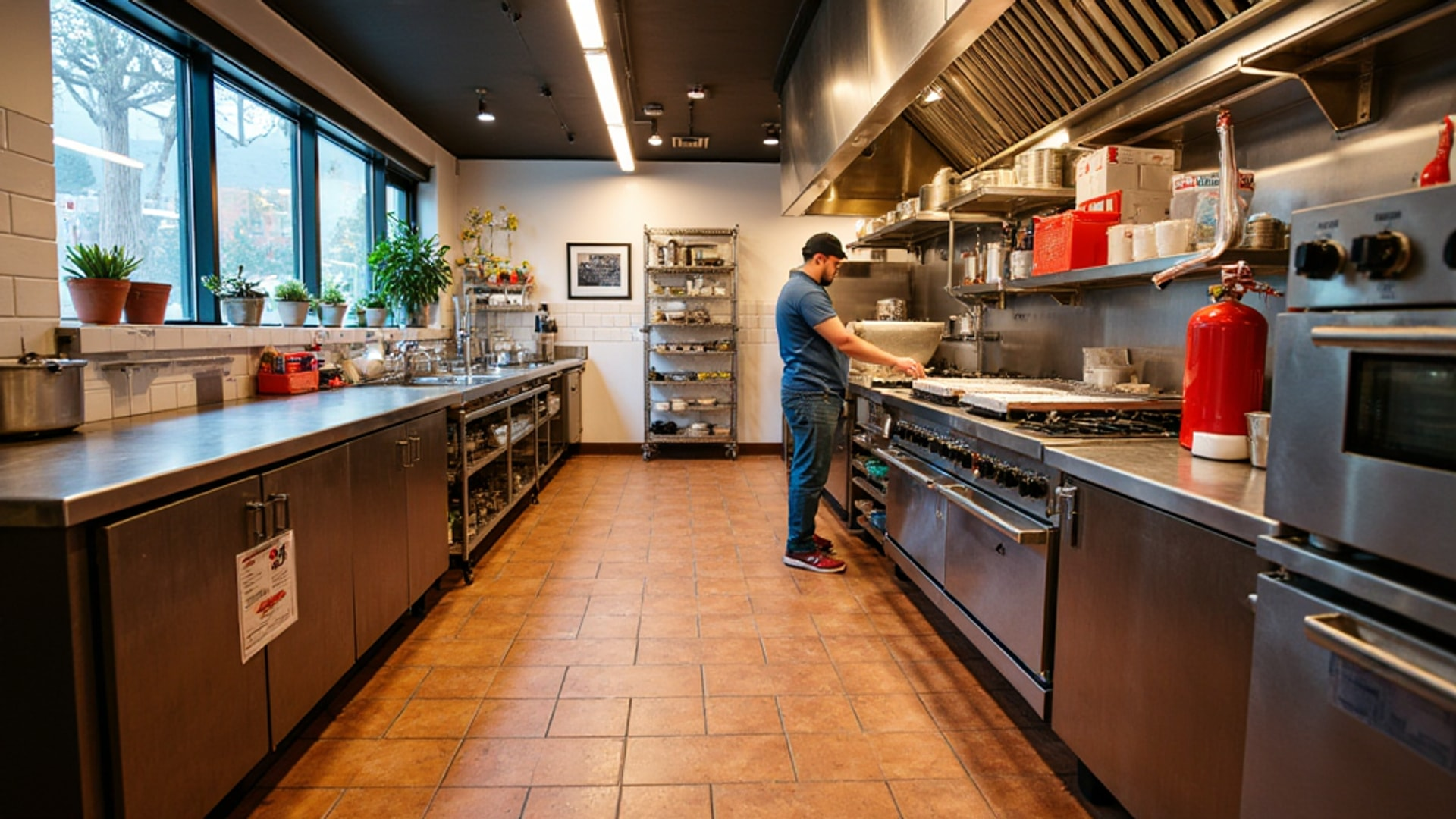
Every commercial kitchen must maintain at least one Class K portable fire extinguisher as backup protection. Class K extinguishers use wet chemical agents specifically formulated for fires involving cooking oils, fats, greases, and food substances. Do not confuse these with standard ABC extinguishers, which are not rated for cooking oil fires.
Class K extinguishers should be accessible to all kitchen staff without requiring them to pass through the fire to reach it. The typical placement is near the exit from the cooking zone, not behind the cooking line. Staff must be trained on the proper technique: activate the suppression system first, then use the extinguisher only if needed to address residual flames.
OSHA’s requirements are direct on this point: regulation 1910.157 mandates an Emergency Action Plan whenever fire extinguishers are present in a workplace.
Installation Requirements
Installation of a commercial kitchen fire suppression system is not a DIY project. Per NFPA 96, installation, repair, and maintenance require a technician who has been properly trained and certified by the system manufacturer. In practice, this means engaging a licensed fire protection contractor with manufacturer certification for the specific system being installed (R-102, Kidde, Amerex, Pyro-Chem, etc.).
The installation process includes a formal system design that accounts for every piece of protected equipment, nozzle positioning calculations to ensure complete coverage, connection to the gas and electrical shutoffs, installation of detection components (fusible links, manual pull stations), and a final acceptance test witnessed by the authority having jurisdiction (AHJ), typically the local fire marshal.
Any permit-required construction or renovation that affects the kitchen area will trigger a suppression system inspection as part of the permit close-out process. Build this inspection into your construction timeline.
Semi-Annual Inspection and Maintenance
NFPA 96 mandates semi-annual professional inspection and maintenance. The inspection includes:
- Checking fusible link condition (they corrode and degrade over time; recommended replacement annually)
- Verifying agent container weight and pressure
- Testing manual pull station function
- Inspecting nozzle positioning and condition
- Verifying gas and electrical shutoff connections
- Checking the entire detection network
- Reviewing system documentation and certification currency
After each inspection, the certified technician attaches a compliance tag to the system with the service date and technician information. Fire inspectors check for this tag during routine inspections and will cite a violation if it’s missing or expired.
Budget for semi-annual inspection as a fixed operating expense. Industry pricing runs from $150 to $500 per semi-annual service visit depending on system size and local market rates.
Staff Training Requirements
The best suppression system in the world is only one layer of protection. Staff training covers what the system cannot do automatically:
- Know the location of all manual pull stations and Class K extinguishers
- Understand the proper response to a kitchen fire: avoid attempting to fight a grease fire with water (which causes explosive steam expansion and can spread burning oil), cover a small flame with a metal lid and turn off the heat, activate the pull station for any fire that cannot be immediately smothered
- Know evacuation routes and muster points
- Understand that once the suppression system activates, the kitchen must be evacuated and emergency services called even if the fire appears to be out. Re-flash and secondary fires are real risks
Regular fire drills, at least quarterly for kitchen staff, make these responses instinctive. The investment of 20 minutes in a drill can prevent the paralysis that costs lives during an actual emergency.
→ Read more: Kitchen Safety Training: Burns, Cuts, Ergonomics, and Emergency Response
Documentation and Inspection Readiness
Keep a dedicated fire safety binder with the following documentation accessible in the kitchen management area:
- Current suppression system certification with technician information and last service date
- Class K extinguisher inspection tags and recharge records
- Fusible link replacement log
- Staff fire safety training records including dates and attendees
- Any correspondence with the AHJ regarding system modifications
Fire inspectors can and do show up without advance notice. Being able to produce this documentation immediately demonstrates the systematic approach that leads to clean inspections and, more importantly, to a kitchen that will actually protect your people and your investment when it matters.
→ Read more: Commercial Kitchen Ventilation: Hood Systems, Codes, and Maintenance
→ Read more: Kitchen Exhaust Hood Cleaning: NFPA 96 Requirements and Practical Maintenance
→ Read more: Kitchen First Aid and Emergency Procedures: Burns, Cuts, and Crisis Response
→ Read more: Fire Code and Occupancy Requirements for Restaurants